Kamia Kennels · Full Blood Elkhound · Norrland Restoration Program
The Kamia Restoration Program
Jamthund to Full Blood — How Aina, Ark, and Torin Rebuilt a Lost Genetic Architecture
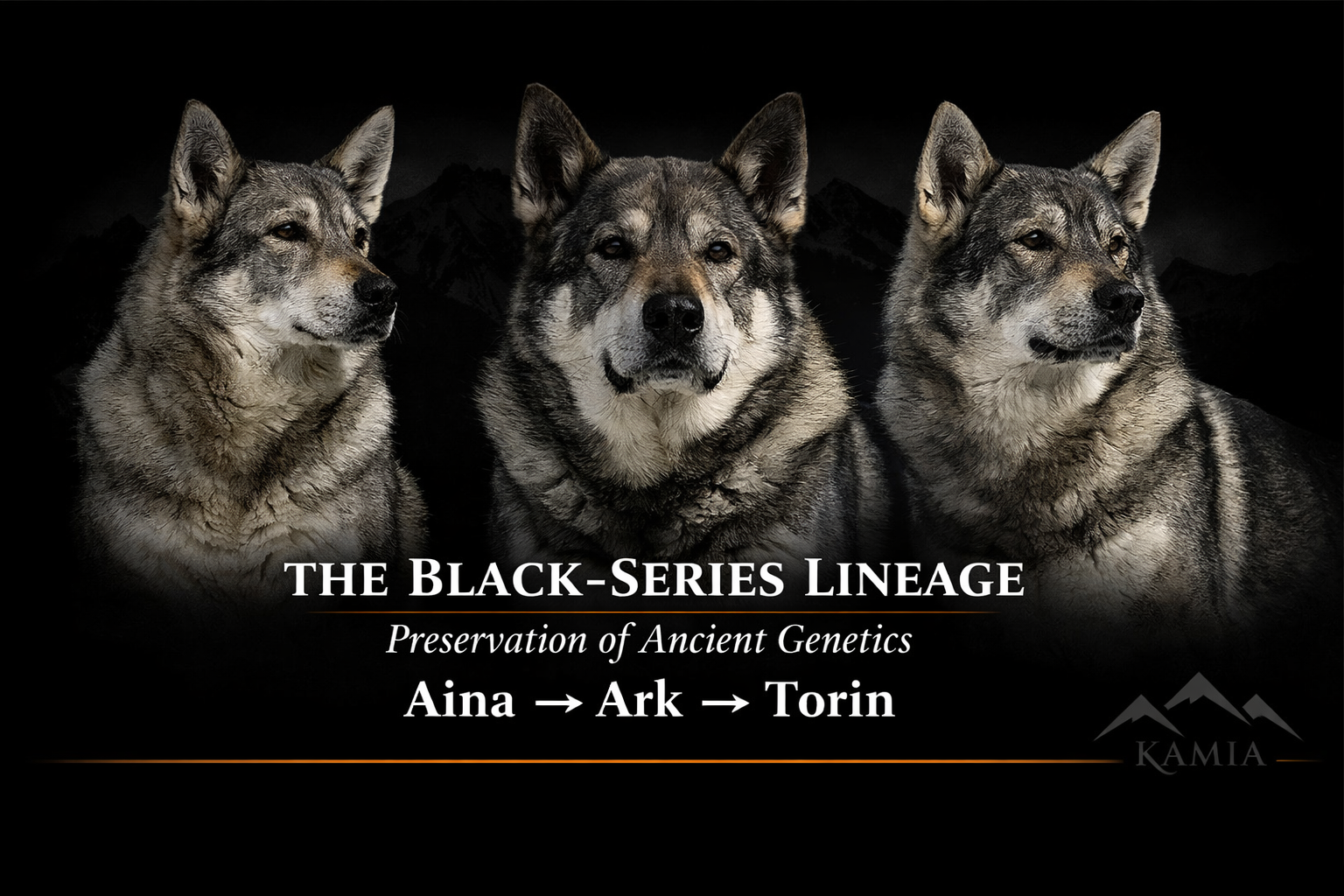
The Kamia Restoration Program exists for one reason: to rebuild the genetic architecture of the ancient Elkhound.
Modern populations are compressed, narrow, and genetically fragile. Restoration requires dogs with breadth, distance, and functional ancestry — not cosmetic traits, not registry purity, and not closed-loop breeding.
The Jamthund-to-Full-Blood pathway is the most important example of how we restore that architecture. It begins with Aina, moves through her son Ark, and culminates in the Full Blood male Torin — a dog whose genetic diversity is so far apart that nothing else in the world resembles it.
This article explains exactly how that architecture was built.
Aina — Foundation Jamthund
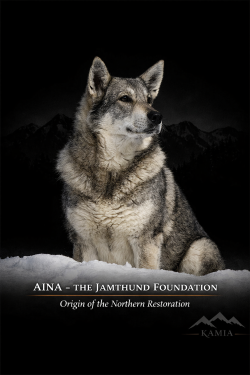
- ancient Jamthund instinct
- maternal intelligence
- structural correctness
- broad working range
Ark — Bridge Male
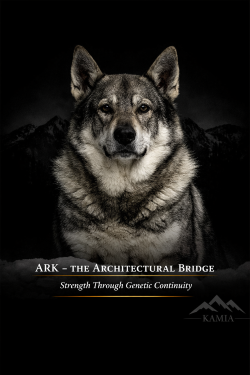
- stability
- endurance
- ancient working architecture
- the magnifier effect
Karu — Norwegian Return Male
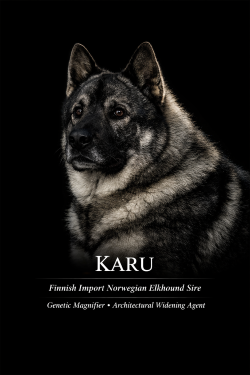
- old-country Norwegian ancestry
- deep working genetics
- structural correctness
- critical diversity input
Ark × Karia — The Full Blood Breakthrough
When Ark was paired with Karia, the result was historic.
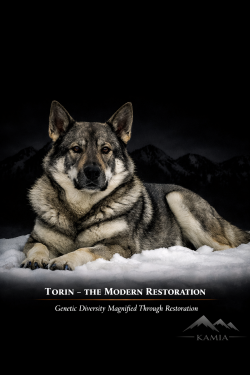
Torin — The Full Blood Male
Torin is the first expression of the restored architecture:
- Jamthund depth from Aina
- Bridge genetics from Ark
- Norwegian Return ancestry from Karia
- Finnish Hunt-Line diversity from Karu
Torin’s genome is so far apart — so distant, so rich, so structurally balanced — that it does not resemble anything in modern Elkhound populations.
He is genetically:
- Jamthund
- Norwegian
- Finnish Hunt-Line
- Restoration-grade
- multi-directional
Torin is the end result of the first phase of the Kamia Restoration Program.
Why Torin Is the Restoration Keystone
Because of how he was built, Torin can go three directions:
Direction 1 — Full Blood Expansion
- the Full Blood population expands
- diversity remains extreme
- the restored architecture strengthens
- the working traits stabilize
- the genetic breadth increases
Direction 2 — Jamthund Return
- the Jamthund line gains massive diversity
- working intelligence increases
- structural stability improves
- the Jamthund architecture becomes deeper and stronger
Direction 3 — Norwegian Return
- the Norwegian line gains the diversity it has lost
- the bottleneck collapses
- instinct returns
- working traits reappear
- the old Norrland ancestry is restored
Why This Works — The Genetic Logic Behind the Architecture
The reason Torin can go three directions is simple:
He carries both sides of the ancestry, but they are extremely far apart.
Torin’s genome contains:
- Jamthund depth
- Norwegian Return ancestry
- Finnish Hunt-Line diversity
- zero compression
- zero bottleneck
- zero closed-loop collapse
This makes him:
- genetically stable
- genetically rich
- genetically distant
- genetically flexible
- genetically restorative
Torin is the first modern Elkhound capable of restoring three populations at once.
The Restoration Program in One Lineage
Aina → Ark → Torin
This is the architecture:
- Aina — foundation Jamthund
- Ark — bridge male
- Karia — Norwegian Return female
- Torin — Full Blood restoration male
This is the model for how restoration is done:
- start with ancient material
- build a bridge
- connect to functional Norwegian ancestry
- produce a Full Blood with extreme diversity
- use that Full Blood to restore multiple populations
Why Torin’s DNA Is Identical — But His Gene Pairs Are Hundreds of Generations Apart
In simple terms, Torin’s DNA is Elkhound DNA — the same basic genetic material that all Elkhounds share. What makes him different is how far apart his gene pairs are.
Every dog has two copies of each gene — one from the mother, one from the father. In modern closed-loop Elkhounds, those two copies are usually almost identical, because the parents share so much ancestry.
This is why modern Elkhounds have:
- narrow diversity
- repeated faults
- shrinking working ability
- temperament drift
- structural compression
Torin is the opposite.
His gene pairs have not met in hundreds of generations.
Torin’s DNA copies come from ancestries so far apart that they have not met in:
- hundreds of generations
- across multiple regional populations
- across Jamthund, Norwegian, and Finnish Hunt-Line ancestry
- across lines that were never allowed to mix in modern breeding
This creates a dog whose DNA is:
- identical in type
- radically different in distance
- genetically rich
- genetically stable
- genetically functional
Conclusion — Torin Is the Proof of Concept
Torin is not just a Full Blood male. He is the demonstration of what restoration architecture can achieve.
He shows:
- how Jamthund depth can be preserved
- how Norwegian ancestry can be restored
- how diversity can be rebuilt
- how working traits can be recovered
- how a single lineage can repair three populations
Torin is the first modern Full Blood Elkhound, and the foundation of everything that comes next.