THE BREEDS · THE PACK · THE LINEAGE
The Dogs of Kamia Kennels
Two ancient northern breeds. One living multigenerational pack.
Kamia maintains two of the most historically significant working breeds in the northern hemisphere — the Norwegian Elkhound of ancient Norrland descent, and the Jämthund. Neither is bred to a show standard. Both are restored to biological purpose.
BREED ONE
The Norwegian Elkhound
Ancient Norrland Line · Not the AKC Norwegian Elkhound
 The
Norwegian Elkhound maintained at Kamia is not the same animal as the Norwegian Elkhound registered with the AKC, the CKC, or governed by FCI breed standards. The distinction is not cosmetic — it is biological and historical. The registered show Norwegian Elkhound descends from a relatively narrow foundation established in the late nineteenth and early twentieth centuries, shaped progressively by show-ring selection for specific physical traits and sized to a breed standard that prioritized appearance over working function. The Ancient Norrland
Norwegian line that Kamia maintains represents a lineage with deeper roots, broader genetic architecture, and a working history that has not been filtered through a century of cosmetic selection.
The
Norwegian Elkhound maintained at Kamia is not the same animal as the Norwegian Elkhound registered with the AKC, the CKC, or governed by FCI breed standards. The distinction is not cosmetic — it is biological and historical. The registered show Norwegian Elkhound descends from a relatively narrow foundation established in the late nineteenth and early twentieth centuries, shaped progressively by show-ring selection for specific physical traits and sized to a breed standard that prioritized appearance over working function. The Ancient Norrland
Norwegian line that Kamia maintains represents a lineage with deeper roots, broader genetic architecture, and a working history that has not been filtered through a century of cosmetic selection.
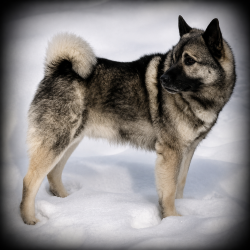 The ancient Norrland Elkhound is, in physical terms, a larger and rangier animal than the show-standard Norwegian Elkhound. It carries more bone, more substance, and a structural architecture designed for genuine northern terrain work — tracking, ranging, locating and holding large game, and operating across snow and rock for extended periods without structural failure. The working posture, the joint architecture, the coat structure, and the neurological organization of the ancient line are meaningfully different from those of the show population, and those differences accumulate in significance across a working lifetime of twelve to fifteen years.
The Finland imports, Norway imports and Sweden imports all
contribute the ancient genetic structure, instincts and skills
combined with the exclusive ancient lines of Kamia Kennels.
The ancient Norrland Elkhound is, in physical terms, a larger and rangier animal than the show-standard Norwegian Elkhound. It carries more bone, more substance, and a structural architecture designed for genuine northern terrain work — tracking, ranging, locating and holding large game, and operating across snow and rock for extended periods without structural failure. The working posture, the joint architecture, the coat structure, and the neurological organization of the ancient line are meaningfully different from those of the show population, and those differences accumulate in significance across a working lifetime of twelve to fifteen years.
The Finland imports, Norway imports and Sweden imports all
contribute the ancient genetic structure, instincts and skills
combined with the exclusive ancient lines of Kamia Kennels.
Behaviorally, the ancient Norrland Elkhound retains working instincts that the show population has, across a century of selection, significantly diluted. The instinct to range, to locate, to hold independently, to communicate with the hunter or handler through specific vocalization patterns, and to work terrain rather than simply move across it — these are functional behaviors that emerge from a combination of genetic architecture and appropriate early development. At Kamia, both the genetics and the developmental environment are designed to preserve and express these traits in every generation.
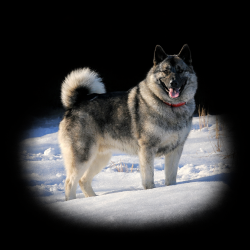 The Golden Ring Elkhound lineage is the ancestral foundation from which Kamia's Norwegian Elkhound program traces its working depth. This lineage represents documented generational continuity with the ancient working population rather than with the registered show breed. The genetic and behavioral depth carried in these lines is, by any objective assessment, irreplaceable — it cannot be recovered from the registered show population once lost, because the traits it carries have not been maintained there.
Kamia Norwegian Elkhounds are intact for life, terrain-living, outdoor-housed, and pack-raised. They are not apartment dogs or suburban companions in the conventional sense — they are northern working animals placed with stewards who understand what they carry and can provide an environment appropriate to their architecture. Dogs from this program routinely reach fourteen to seventeen years of age with full mobility and cognitive clarity, a longevity profile that stands in direct contrast to the eight-to-twelve-year average of the registered show population.
"The registered Norwegian Elkhound and the ancient Norrland Elkhound share a name and a general silhouette. Beyond that, the biological distance between them is significant — and widening with every generation of show selection." — Kamia Kennels Breed Documentation
BREED TWO
The Jämthund — Swedish Elkhound
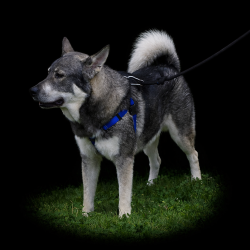 One of the most under-represented working breeds in North America
The Jämthund, recognized in Sweden as a distinct breed from the Norwegian Elkhound since 1946 but sharing common ancient ancestry, is one of the most working-capable and historically significant spitz-type breeds in the northern hemisphere. In Scandinavia, the Jämthund is a respected hunting breed with a documented working history stretching back centuries. In North America, it is functionally invisible — the registered population is negligible, the awareness among working dog communities is minimal, and the genuine working lineage has, in many respects, been lost entirely from the continent. Kamia Kennels is engaged in the restoration and forward transmission of this breed in North America through the Desna Program — a deliberate, multi-decade effort to establish a genetically viable and behaviorally intact Jämthund population in Canada.
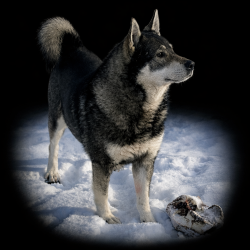 The Jämthund is larger than the Norwegian Elkhound by a meaningful margin — taller, heavier-boned, and with a working architecture suited to the pursuit and holding of larger game including moose and bear. The breed carries extraordinary physical capacity: deep chest, dense musculature, powerful hindquarters, and a structural integrity that supports sustained terrain work across northern conditions. Behaviorally, the Jämthund is characterized by independence, confidence, and a calm assertiveness under pressure that differs from the more reactive temperament of many spitz-type breeds developed in isolation or under show selection.
What makes the Jämthund particularly significant from a genetic standpoint is the depth of working selection pressure it has experienced in Scandinavia over many centuries — selection applied not for cosmetic traits but for functional performance in demanding northern conditions. This depth of working selection produces animals with behavioral and structural integrity that is genuinely difficult to find in other breeds and effectively impossible to replicate through short-term selection programs. The Jämthund that Kamia maintains carries this selection history in its genetics. Preserving and transmitting it is, from the standpoint of working breed history, an act of genuine conservation.
BREED three
The Fullblood Elkhound
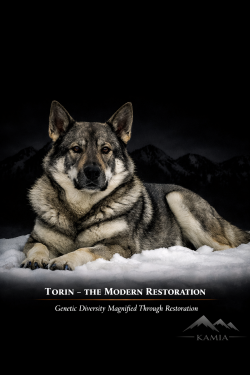 The
Full Blood Elkhound is the original northern working companion, a
true heritage dog preserved through documented lineage, functional
structure, and instinctive intelligence. At Kamia Kennels, the Full
Blood designation means an Elkhound that traces directly to the
authentic Scandinavian working populations, free from cosmetic
breeding trends or modern dilution. These dogs carry the classic
traits that defined the breed for centuries — stamina, awareness,
independence, loyalty, and the steady temperament that makes them
exceptional family companions. A Full Blood Elkhound represents
genetic integrity, ancestral resilience, and the timeless northern
character that Kamia has worked for decades to protect.
The
Full Blood Elkhound is the original northern working companion, a
true heritage dog preserved through documented lineage, functional
structure, and instinctive intelligence. At Kamia Kennels, the Full
Blood designation means an Elkhound that traces directly to the
authentic Scandinavian working populations, free from cosmetic
breeding trends or modern dilution. These dogs carry the classic
traits that defined the breed for centuries — stamina, awareness,
independence, loyalty, and the steady temperament that makes them
exceptional family companions. A Full Blood Elkhound represents
genetic integrity, ancestral resilience, and the timeless northern
character that Kamia has worked for decades to protect.
The Full Blood Program — Establishing and preserving this Full Blood lineage has required decades of careful selection, historical research, and the protection of old‑world traits that were disappearing from modern breeding. Kamia’s preservation work focuses on maintaining the ancestral structure, the northern working instincts, and the genetic diversity that once defined the Elkhound across Norway, Sweden, and the broader Scandinavian region. Through senior‑male mentorship, maternal dynasties, and strict adherence to functional heritage, the Full Blood Elkhound remains a living example of the original northern dog — resilient, intuitive, and true to its ancestral purpose.
"The Jämthund has been shaped by centuries of selection pressure that no short-term breeding program can replicate. What it carries is genuinely irreplaceable. The Jamthund Program exists because someone has to carry it forward." — Kamia Kennels, The Desna Program Notes
THE PACK
Living Multigenerational Architecture
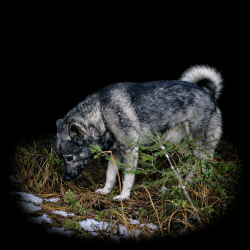 The pack at Kamia is not a collection of individually housed breeding animals. It is a functioning multigenerational social system — grandfathers, fathers, sons, uncles, and half-brothers living and working together across a range of ages from young dogs to senior males in their twelfth and thirteenth years. This is not a housing arrangement. It is the fundamental mechanism through which the behavioral memory of the ancient northern dog is transmitted from one generation to the next.
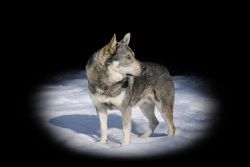 Senior males at Kamia — dogs aged seven, nine, twelve, fourteen years — are not retired breeders maintained as pets. They are active members of the pack whose presence shapes the behavioral development of every younger dog and every litter born into the program. The calmness, the range confidence, the social intelligence, the emotional neutrality under pressure — these traits are not trained into Kamia pups. They are modeled, daily, by animals who have already integrated them across years of lived pack experience. The mechanism is not instruction. It is inhabitation.
No other program in any working breed anywhere in the world currently maintains this architecture. The global breeding standard eliminates old males as economically unproductive once their peak stud years pass. Kamia does the opposite: the older a male is, and the sounder he remains, the more central his role in the pack becomes. The longevity of Kamia dogs — routinely reaching fourteen to seventeen years with full mobility — is itself a function of this architecture. These animals are not maintained beyond their useful years. Their useful years simply extend much further than the global standard expects.
THE DOGS OF KAMIA KENNELS
Names That Carry the Lineage
The Kamia program spans three distinct breed lines — the Jämthund, the Norwegian Elkhound, and the Full Blood Elkhound. Every dog listed here carries a specific role in the architecture: foundational female, lineage bridge, stewardship male, or upcoming generation.
JÄMTHUND · SWEDISH ELKHOUND
The Jämthund Program
Kamia's Jämthund base forms the foundation of the Jämthund Return Program — one of the most serious Jämthund restoration efforts in North America.
Varella
JÄMTHUND · FOUNDATION FEMALE
Varella is the cornerstone foundation female of the Kamia Jämthund program — still active in the pack. Her continued presence as a functioning pack member makes her one of the most significant animals in the entire Kamia system.
Aurella
JÄMTHUND
Aurella contributes essential genetic and behavioral depth to the Jämthund program, representing an important strand of the female lines that anchor the Jämthund Return Program's long-range breeding architecture.
Ark
JÄMTHUND
Ark carries critical Jämthund genetics within the Kamia system, providing working depth from a distinct northern line. His genetics broaden the program's Jämthund ancestral base and support the integrity of the Return Program.
ARCO
JÄMTHUND · SIRE
ARCO is a pivotal sire within the Kamia Jämthund program. His daughters — Vaeda and Nyra, the latter produced with Revna — represent the bridge between the Jämthund and Full Blood Elkhound programs, a deliberately architected genetic connection.
Posso
JÄMTHUND
Posso is a significant contributor to the Jämthund program, carrying working ancestral depth that complements the broader genetic architecture Kamia maintains across this breed line.
NORWEGIAN ELKHOUND · CURRENT PACK
Norwegian Elkhounds — The Active Lines
Kamia's Norwegian Elkhound pack includes animals of distinct lineage significance — Finnish connections, foundational dams, and key sires whose genetics anchor the Norwegian Elkhound Return Program.
Teeko
NORWEGIAN ELKHOUND · SIRE
Teeko's pairing with Karia produced the Ancient Norrland litter — a milestone in Kamia's effort to preserve the full-blood ancient Norrland line distinct from the registered show population.
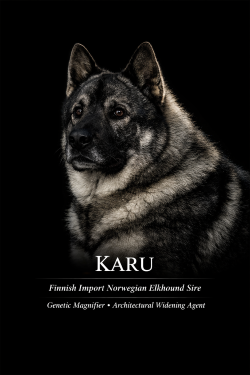
Karu
NORWEGIAN ELKHOUND · FINNISH CONNECTION
Karu represents Kamia's Finnish-Norwegian lineage link — a connection to the working Scandinavian population that broadens the program's ancestral base beyond the North American registered gene pool.
Varja
NORWEGIAN ELKHOUND · LINEAGE BRIDGE
Varja is the primary link between the Tekla and Karu lines — a dog of particular architectural significance whose placement in the generational sequence connects two critical ancestral threads within the Norwegian Elkhound program.
Revna
NORWEGIAN ELKHOUND · DAM
Revna is a key dam in the Norwegian Elkhound program and carries additional significance as the dam of Nyra — a Full Blood Elkhound female produced with ARCO — making her a deliberate bridge between two of Kamia's three breed programs.
Karia
NORWEGIAN ELKHOUND · DAM
Dam of the Teeko × Karia Ancient Norrland litter. Her lineage traces directly to the ancient working population, representing the depth of ancestral architecture that the Norwegian Elkhound Return Program is designed to preserve and transmit.
Kaleva
NORWEGIAN ELKHOUND
Kaleva contributes to the Norwegian Elkhound program's active genetic base, carrying working line depth that supports the program's long-range selection objectives.
Silver Nessa
NORWEGIAN ELKHOUND · DAM · GOLDEN RING LINE
Silver Nessa carries the Golden Ring Elkhound heritage and is the dam of upcoming Silver Moon. Through her, the Golden Ring lineage — one of the most historically significant working Elkhound lines — is carried forward into the next generation of the program.
NORWEGIAN ELKHOUND · UPCOMING & STEWARDSHIP
The Next Generation & Stewardship Males
UPCOMING
Lil Griz
NORWEGIAN ELKHOUND · UPCOMING · PRETTY BOY LEIF & RITA LINE
Lil Griz is Kamia's direct link to the Pretty Boy Leif and Rita genetic line — an ancestral connection that preserves a specific thread of working line.
Riatta
NORWEGIAN ELKHOUND · UPCOMING · TEKLA–LUNA MATERNAL DYNASTY
Riatta is the final daughter of Luna and a direct continuation of the Tekla maternal dynasty — one of the strongest and most historically important female lines in the breed. She carries the deep Scandinavian working intelligence, structural correctness, and calm northern temperament that define Kamia’s preservation females. Her upcoming litter represents a rare extension of this old‑world lineage into the modern era.
Moki
NORWEGIAN ELKHOUND · UPCOMING · GAEDA MATERNAL LINE · 3RD GENERATION
Moki is the first genetic shift in the Kamia program in over fourteen years — a preservation male from Gaeda’s elite maternal line, carrying the calm, steady temperament and structural correctness that define the original northern Elkhound. His upcoming litters represent the fourth generation of Kamia’s long‑term preservation work, extending a rare and historically important lineage into the modern era.
UPCOMING
Nyra
FULL BLOOD ELKHOUND · UPCOMING · LUNA–REVNA NORTHERN LINE
Nyra is a Full Blood Elkhound from the Luna–Revna northern line, carrying the original Scandinavian structure, instinct, and calm working intelligence. Her upcoming litter represents a continuation of Kamia’s preservation work, maintaining the old‑world traits that define the true northern Elkhound.
Silver Moon
NORWEGIAN ELKHOUND · UPCOMING · TEKLA–LUNA MATERNAL DYNASTY
Silver Moon is a rising female in the Tekla–Luna maternal dynasty, carrying the calm temperament, structural correctness, and intuitive northern awareness that define Kamia’s preservation females. Her upcoming litter continues one of the most stable and historically important female lines in the program.
Dagr
NORWEGIAN ELKHOUND · UPCOMING · SENIOR MALE PRESERVATION LINE
Dagr is Kamia’s senior‑male preservation prospect, carrying the calm authority, working intelligence, and structural balance that define the original northern male Elkhound. His upcoming pairing represents a major continuation of Kamia’s long‑term preservation architecture.