The Elkhound began as a northern landrace — a broad, adaptive working population shaped by terrain, climate, and the practical needs of families across Scandinavia. For thousands of years, the dogs of Norway and Sweden existed as regional expressions of the same functional type. They were not breeds. They were not standardized. They were shaped by land, work, and necessity.
The Norwegian Expression — Mountain Dog of the West
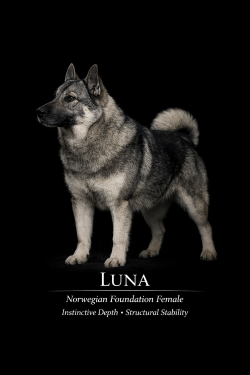
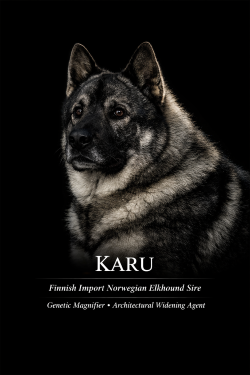 In the steep, rugged terrain of western and central Norway, hunters needed a compact, powerful dog capable of explosive strength, tight maneuvering, and sustained endurance across vertical country. The Norwegian expression developed naturally under these pressures. Dense bone, strong ligament, deep chest, and a close‑coupled frame allowed these dogs to climb shale, navigate ledges, and work moose in tight terrain. Their working style emphasized agility, rapid decision‑making, and close handler awareness — traits essential for hunting in narrow valleys, rock faces, and snow‑loaded ridges.
The Swedish Expression — The Larger Grahund of the Interior
 Across the border in Sweden, the same landrace produced a larger Norwegian-type dog — historically called the Grahund. Swedish hunters working long-range forest terrain selected for more leg, more length, and more range. These dogs were still Norwegian Elkhounds in origin, but expressed through different terrain. They were taller, rangier, and built for covering ground efficiently in deep forest and deep snow.
This is the key point: Sweden’s “Norwegian Elkhound” was simply bigger — because their terrain demanded it.
The 37-Year Disagreement — Norway and Sweden Define Their Types
When Norway began formalizing the Norwegian Elkhound standard in the late 19th century, they defined a smaller mountain-type dog. Sweden did not agree. For thirty‑seven years, Swedish breeders refused to accept Norway’s size standard because Sweden’s own Norwegian-type dogs were larger, rangier, and built for forest terrain. They did not want their dogs forced into a smaller Norwegian definition.
This disagreement was not about the Swedish Elkhound (Jämthund). That came later. This was simply Sweden saying: “Our Norwegian-type dogs are bigger. We are not adopting your smaller standard.”
The 1946 Swedish Classification — The Jämthund Becomes a Breed
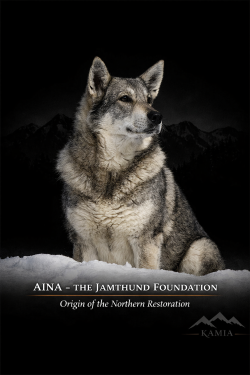 In 1946, Sweden made a separate administrative decision: they formally classified the Swedish Elkhound — the Jämthund — as its own breed. This was not the same disagreement as the earlier size dispute. This was a new event, decades later. The Jämthund was the largest forest-terrain expression of the landrace, present for centuries before being formally named.
This dog was normally found in remote regions, focused primarily on hunting Moose and Bear.
It was found in large parts of the Jamtland region of Sweden, thus the reason for the name.
This landrace dog, was a serious hunt companion.
Kamia Kennels — The Only Program Preserving All Three Expressions
Today, Kamia Kennels is the only breeder in North America maintaining all three historic expressions of the northern landrace — the full continuum that once stretched across Norway and Sweden before administrative definitions separated them.
1. The Swedish‑Based, Larger Norwegian Type (Norrland Expression)
This is the historic Swedish version of the Norwegian Elkhound — the larger Grahund-type dog selected for forest range, deeper snow, and long-distance pursuit.
2. The Norway‑Based Mountain‑Sized Norwegian Elkhound
The compact, powerful mountain dog shaped by Norway’s steep terrain and vertical hunting demands.
3. The Swedish Elkhound (Jämthund)
The largest forest-range expression of the landrace, formally named in 1946 but present long before.
Explore the Living Landrace at Kamia Kennels
For readers who want to see these historic expressions alive today, Kamia Kennels maintains the full northern continuum in working form. Our Swedish-based Norrland lines preserve the larger forest-range Norwegian type. Our Norway-based lines preserve the compact mountain dog. And our Jämthunds represent the largest and most far-ranging forest expression. Together, these three lines form a living demonstration of the original northern landrace — preserved across terrain, temperament, and working architecture.
Explore our Jamthunds, Norwegians, and Full Blood Norrland dogs across the Kamia program — the living archive of the northern landrace, carried forward in real terrain, real pack structure, and real working architecture.